
Aluminum Radiator Guard | Shih Yeh Precision Stamping
Custom aluminum radiator guard with hexagonal perforations. Shih Yeh delivers precision stamped guards with anodizing and surface treatment for motorcycles.
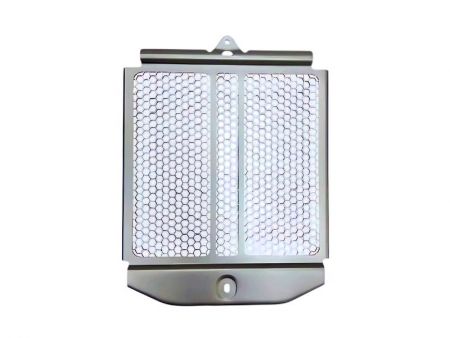
Hexagonal Mesh Punching & Flatness Control | Custom Aluminum Motorcycle Radiator Guard
2 mm Aluminum Sheet with Approximately 800 Hexagonal Perforations and 1.3 mm Metal Web Width
Shih Yeh manufactures custom aluminum motorcycle radiator guards according to customer drawings. This part features a hexagonal mesh pattern formed by punching approximately 800 openings into a 2 mm aluminum sheet measuring 230 × 230 mm, with a metal web width of approximately 1.3 mm.
Dense perforation can cause warping, twisting and localized deformation. Key manufacturing considerations therefore extend beyond forming the hexagonal openings to controlling deformation of the metal webs, flatness of the perforated area, mounting-hole positions and subsequent forming dimensions. The perforated area has a drawing-specified flatness tolerance of 4 mm, while production inspection also covers mounting features and the perforated structure.
Aluminum Motorcycle Radiator Guard Case Summary
| Part Type | Aluminum motorcycle radiator guard |
| Application | Radiator protection for motorcycles |
| Customer Markets | Europe and North America |
| Customer Types | Motorcycle brands and aftermarket motorcycle parts brands |
| Manufacturing Model | Development from customer 2D/3D drawings and OEM volume production |
| Project Status | Development completed; in stable volume production |
| Material | Aluminum alloy |
| Sheet Thickness | 2 mm |
| Part Dimensions | Approx. 230 × 230 mm |
| Perforation Pattern | Approx. 800 hexagonal perforations |
| Metal Web Width | Approx. 1.3 mm |
| Perforated-Area Flatness | 4 mm |
| Key Manufacturing Focus | Sheet deformation and flatness control after high-density perforation |
| Surface Finishing | Polishing, sandblasting and clear anodizing |
High-Density Hexagonal Mesh Punching and Sheet Deformation Control
In addition to providing frontal protection, a radiator guard must account for how its perforated structure affects airflow. Hole geometry, metal web width and the overall opening layout are therefore important design and manufacturing considerations. This part uses a 2 mm aluminum sheet measuring approximately 230 × 230 mm, with around 800 hexagonal perforations produced in multiple punching operations. Repeated punching introduces and releases stresses that can deform the sheet. The high density of openings also leaves less material between holes; with metal webs approximately 1.3 mm wide, the perforated area is particularly susceptible to punching forces.
After extensive punching, the sheet may warp, twist or deform locally, affecting the flatness of the perforated area. Controlling deformation and flatness is a central manufacturing challenge. Beyond producing the approximately 800 openings, the process must manage sheet distortion throughout punching and subsequent flattening. Punching methods and sequence, in-process flattening or reshaping, and subsequent correction are used to meet the specified 4 mm flatness requirement.
1.3 mm Metal Webs and Hexagonal Mesh Structure
The metal webs remaining between adjacent hexagonal openings are approximately 1.3 mm wide. Because these connecting sections are narrow, they are vulnerable to deformation and punching forces. Manufacturing controls address bending, twisting, stretching and fracture risks, while also monitoring web-width consistency and the effect of the perforated structure on overall panel flatness.
As the approximately 800 openings are punched in multiple stages, the material structure of the perforated area progressively changes. Accurate workpiece positioning and placement are therefore important alongside web-width control to reduce the risk of localized deformation or structural irregularities. Production checks cover metal web width, panel flatness and distortion, burrs, edge cracking and other material abnormalities.
Mounting Dimensions and Production Inspection
In addition to the perforated structure, mounting-hole dimensions, hole positions and spacing, and bending or forming dimensions are important production control points. Because the radiator guard must fit related motorcycle components, its overall shape, mounting locations and relevant dimensions are checked against the customer drawings after punching and forming.
During final inspection, dedicated gauges are used to check mounting-related dimensions and flatness, while calipers are used to measure the metal web width between hexagonal openings. Other dimensions are checked with general measuring tools or a coordinate measuring machine (CMM), as appropriate. After a dedicated inspection gauge is manufactured, its dimensions are first verified using a CMM before the gauge is used for subsequent production inspections.
Visible Surface Appearance and Finishing Requirements
After punching and forming, the aluminum component undergoes polishing, sandblasting, and clear anodizing, with visible surface appearance and finish quality controlled according to project-specific requirements. The anodizing specifications for this production project include a minimum average coating thickness of 10 μm and a 240-hour salt spray test requirement. These specifications apply only to this project and do not represent standard requirements for other custom parts.
In addition to the clear anodized finish used in this project, other custom aluminum stamped parts can be evaluated for anodized finishes in colors such as black, dark gray, gold, blue, and red. Achievable colors, color consistency, and surface appearance depend on the aluminum alloy, surface condition, and project-specific requirements.
Potential Applications | High-Density Perforated Metal Components
Experience with dense hexagonal perforation, narrow metal webs and sheet deformation control can also inform manufacturability assessments for other metal components requiring ventilation, protection or heat-dissipation openings. Hole geometry, web width, material thickness, flatness and forming requirements must be evaluated against each customer's drawings.
• Radiator guards, radiator grilles and air intake grilles: automotive, motorcycle and transportation equipment
• Fan guards, perforated cooling panels and ventilation panels: electronics, electrical machinery and cooling equipment
• Machine guards and protective mesh covers: industrial machinery, automation and production equipment
• Ventilated enclosure panels and equipment covers: electronics, control cabinets and industrial equipment
• Speaker grilles and audio panels: audio equipment and consumer electronics
• Decorative perforated panels and metal mesh panels: equipment housings, structural parts and consumer products
Provide Drawings for a Manufacturing Feasibility Review
If your project involves dense perforations, narrow metal webs, sheet deformation, flatness requirements or critical mounting-hole locations, please share your drawings and project specifications. Shih Yeh can review manufacturing feasibility and the information needed for a quotation.
For an RFQ, please provide 2D drawings or 3D models, material, sheet thickness, overall dimensions, hole pattern and web dimensions, critical dimensions and tolerances, mounting datums, surface finishing, appearance and testing requirements, and estimated order quantities. Where the part must fit a radiator, bracket or other assembly, relevant assembly information will also support the engineering review.
- Related Products
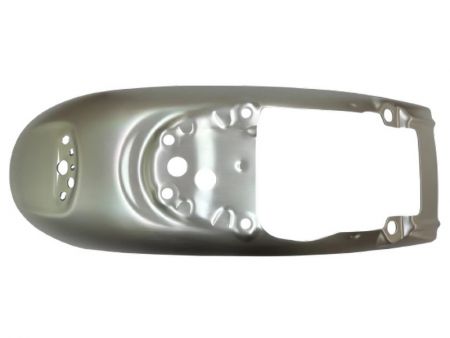
3D Curved Forming & Cosmetic part Production | Custom Aluminum Mudguard
Shih Yeh provides OEM manufacturing services for custom aluminum front and rear motorcycle...
Details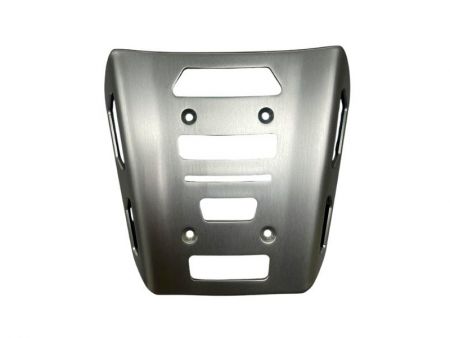
4mm Aluminum Fine Blanking and Cosmetic Part | Custom Motorcycle Luggage Rack
This aluminum motorcycle luggage rack is a custom mass-produced part for motorcycle brands...
Details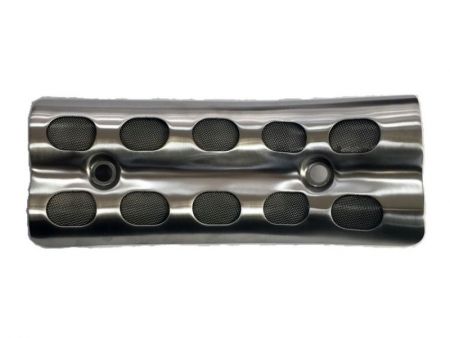
Custom Metal Motorcycle Covers, Shields & Guards
with experience in complex stamped geometries and appearance-critical parts. Forming control...
Details- Related FAQ
Can You Manufacture Custom Sizes and Shapes from 2D/3D Drawings?
Yes. Shih Yeh can review customer-supplied 2D and 3D drawings for custom sizes, profiles, curved surfaces, hole locations, bending, deep drawing, welding,...
What Anodizing Colors, Coating Thicknesses, and Salt Spray Test Conditions Are Available for Aluminum Parts?
Shih Yeh can evaluate clear, black, gold, blue, red, and other specified anodized colors according to customer drawings and cosmetic requirements. Before...
Popular Products

How can you ensure consistent quality and precise fit for complex perforated radiator guards in high-volume motorcycle production?
Shih Yeh's specialized punching die technology and multi-step stamping process guarantee consistent hexagonal hole shapes, spacing accuracy, and structural integrity across all components. With 36 years of precision metal stamping expertise and strict quality control standards, we control deformation at every production stage to ensure perfect radiator alignment and seamless integration with your motorcycle assemblies. Our in-house tool room eliminates costly outsourcing and accelerates turnaround times—contact us to discuss your specific production requirements and custom tooling solutions.
Beyond stamping, Shih Yeh delivers complete integrated manufacturing solutions including precision surface treatments tailored to your specifications. We offer anodizing to enhance corrosion resistance and durability, sandblasting for aesthetic matte textures, and additional finishing options such as powder coating and electrophoretic coating. By partnering with us, you gain access to comprehensive metal stamping expertise, advanced perforated metal forming capabilities, and customized production solutions that meet both technical and visual requirements—ensuring your radiator guards achieve superior protection, durability, and market-ready quality.