
Aluminum Crankshaft Retainer | Shih Yeh Marine Engine
Precision stamped aluminum crankshaft retainers for marine engines with semi-hard anodizing. Tight tolerance hole positioning and corrosion resistance.
Aluminum Crankshaft Retainer for Marine Engine Applications
Precision Metal Forming Component with Semi-hard Anodizing for Marine Engines
This aluminum alloy component is used in marine engine systems as a crankshaft retainer, where tight hole diameter tolerance, hole position accuracy, and profile of surface tolerance are critical to assembly stability and engine reliability. Crankshaft retaining components in marine engines must maintain precise alignment and structural stability under continuous vibration, high load, and corrosive environments, making dimensional control and surface durability critical.
Shih Yeh provides precision metal forming and stamping capabilities to control key dimensions and surface profiles consistently. Based on application requirements, clear semi-hard anodizing with a coating thickness of 20 μm or greater can be applied to enhance corrosion resistance, wear resistance, and surface durability, supporting long-term performance under high-load and continuous marine engine operating conditions.
Precision Control of Hole Diameter and Hole Position Tolerances
In marine engine applications, crankshaft-related components require strict control of hole diameter and hole position tolerances to ensure accurate alignment, secure fastening, and stable engine operation. Shih Yeh addresses these requirements at the process design stage by evaluating the most suitable forming and machining methods based on tolerance demands, material behavior, and downstream surface treatment effects.
Through stable metal stamping and forming control, combined with defined process sequencing and dimensional management, critical hole features are consistently maintained within drawing specifications. This approach reduces assembly variation and supports reliable performance across mass production and long-term engine operation.
In mass production, failure to account for material springback and the dimensional impact of downstream anodizing can lead to assembly variation or rework risks. These factors are therefore evaluated early in the process design stage.
Profile Tolerance Management for Curved Surface Accuracy
In addition to hole-related tolerances, this component includes profile of surface tolerance requirements to ensure proper contact and load distribution within the marine engine structure. During manufacturing, Shih Yeh plans forming sequences and deformation control strategies to manage material flow and minimize distortion or springback that could affect surface profile accuracy.
By maintaining consistent forming conditions and process control, curved surface geometry is kept within specified profile tolerance limits, supporting structural stability, accurate assembly, and long-term durability in marine engine environments.
Semi-hard Anodizing for Corrosion Resistance and Surface Durability
This product is finished with clear anodizing, with semi-hard anodizing applied according to application requirements. The semi-hard anodizing process achieves a coating thickness of 20 μm or more, providing enhanced corrosion resistance, weather resistance, surface hardness, wear resistance, electrical insulation, and heat resistance.
Compared to standard anodizing, this thicker anodic layer is particularly suitable for marine engine components exposed to moisture, salt, vibration, and elevated temperatures over extended service periods.
Manufacturing Capability and Application Scope
This aluminum alloy formed component is suitable for parts that require medium material strength, good formability, and stable control of hole tolerances, surface profile accuracy, and overall dimensions. It is commonly used for crankshaft retainers, locating parts, and supporting structural components in marine engine systems.
In addition to marine engines, these manufacturing capabilities can also be applied to parts used in transportation equipment, power transmission systems, industrial machinery, and instrumentation. These applications often require lightweight design, corrosion resistance, and reliable assembly fit. Processing methods, tolerance requirements, and surface finishes are defined based on customer drawings and application needs to support stable mass production, consistent assembly quality, and long service life.
- Related Products
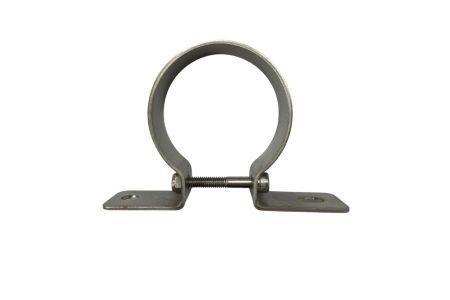
Marine Fuel System Stainless Steel Bracket with Roll Formed Stamping Process
This stainless steel bracket is manufactured for marine equipment applications and used as a mounting...
Details
Popular Products
How can you eliminate assembly variation and ensure reliable crankshaft retainer performance in high-vibration marine engine environments?
Shih Yeh's precision metal stamping with advanced dimensional control and semi-hard anodizing coating (20 μm+) delivers consistent hole positioning accuracy and superior corrosion resistance. Our in-house tool room and integrated manufacturing process—from forming through surface treatment—reduce rework risks and assembly variation, supporting stable mass production and long-term marine engine reliability. Contact us to discuss your specific tolerance requirements and surface finish specifications.
To enhance performance in corrosive marine environments, Shih Yeh applies clear semi-hard anodizing with coating thickness of 20 μm or greater, delivering superior corrosion resistance, wear resistance, and surface durability. This integrated manufacturing approach—combining precision metal forming, process sequencing, dimensional management, and specialized surface finishing—reduces assembly variation and supports long-term reliability across marine propulsion systems, power transmission equipment, and industrial machinery applications.