
What Is the Difference Between Fine Blanking and Conventional Stamping? Which Metal Parts Are Suitable for Fine Blanking?
Fine blanking is a stamping process used to improve the sheared-edge quality of metal parts. Compared with conventional stamping, it can increase the proportion of the smooth sheared surface and reduce local tearing cuts, burrs, and rough edges. It is suitable for parts with higher requirements for edge appearance, contour, and dimensional tolerances.
Shih Yeh can evaluate fine-blanking tooling and mass-production feasibility according to the customer drawing, material, thickness, part geometry, and sheared-edge requirements.
Fine Blanking vs Conventional Stamping
When material is separated by conventional stamping, the sheared edge usually includes rollover, tearing cuts, and burrs. The tearing-cut area may become more obvious as material thickness increases. Fine blanking is mainly used to increase the proportion of the smooth sheared surface, improve edge integrity, and reduce the effect of tearing cuts and burrs on subsequent assembly, appearance, or machining.
| Comparison Item | Conventional Stamping | Fine Blanking |
|---|---|---|
| Sheared edge | The tearing-cut area is usually more obvious | Can increase the proportion of the smooth sheared surface |
| Burrs | May be more noticeable depending on the material and tooling condition | Can reduce burrs and rough edges |
| Edge appearance | Suitable for general blanking requirements | Suitable for parts with higher sheared-edge appearance requirements |
| Dimensional requirements | Controlled under conventional stamping conditions | Can support higher dimensional and contour requirements |
| Tooling management | Requires maintenance according to production conditions | Tooling accuracy and maintenance condition have a greater effect on sheared-edge quality |
Whether conventional stamping or fine blanking should be used must be evaluated according to the customer drawing, sheared-edge requirements, material, and thickness.
Materials, Geometries, and Reference Case Ranges
Shih Yeh has fine-blanking experience with aluminum alloys, carbon steel, stainless steel, and copper.
External profiles, round holes, irregular holes, slots, large openings, tooth profiles, and other special geometries can be evaluated from customer drawings. If a design contains excessively sharp corners, the risk of local cracking, faster tooling wear, or unstable processing may increase, so feasibility must be confirmed from the actual drawing.
| Item | Previous Case Reference |
|---|---|
| Material thickness | Approximately 0.5–8 mm |
| Maximum external dimensions | Approximately 300 × 300 mm |
| Smooth sheared-surface requirement | Previous projects have required approximately 80%–90% smooth sheared surface |
The ranges above are references from previous projects and do not mean that the same conditions apply to every material, size, or geometry. Actual feasibility must be confirmed according to the material grade and condition, thickness, external profile, opening arrangement, sharp corners, smooth-surface requirement, and tooling conditions.
Can Fine Blanking Completely Eliminate Burrs?
Fine blanking can reduce burrs and tearing cuts, but it cannot guarantee complete elimination under all conditions. Actual edge quality is affected by material characteristics, thickness, geometric complexity, local sharp corners, and tooling condition.
If the process or tooling condition is not properly controlled, the following issues may occur:
• Rough sheared edges or a reduced proportion of the smooth sheared surface
• Local tearing cuts, rollover, or burrs
• Part deformation, local cracking, or external-profile deviation
Fine-blanking tools gradually wear during continuous production. As wear increases, the smooth sheared area may decrease, while tearing cuts and burrs may become more obvious. In-process inspection and tooling maintenance are therefore required to maintain mass-production quality. Actual burr and sheared-edge requirements are confirmed according to the customer drawing and project quality specifications.
How Are Fine-Blanked Parts Inspected?
Depending on the part characteristics and customer requirements, quality can be confirmed using:
• Visual inspection
• Caliper measurement
• Coordinate measuring machine inspection
• Dedicated inspection fixtures
Inspection usually covers external dimensions, profiles, sheared-edge condition, burrs, and drawing-specific requirements. The actual inspection method and sampling frequency are confirmed according to the project quality specifications.
For metal parts with specific requirements for sheared-edge condition, smooth-surface ratio, burrs, external profiles, or dimensional tolerances, please provide 2D/3D drawings, material, thickness, external dimensions, sheared-edge standards, and estimated demand. Shih Yeh can evaluate fine-blanking tooling and mass-production feasibility according to the part structure, material, and quality requirements.
- Related Case
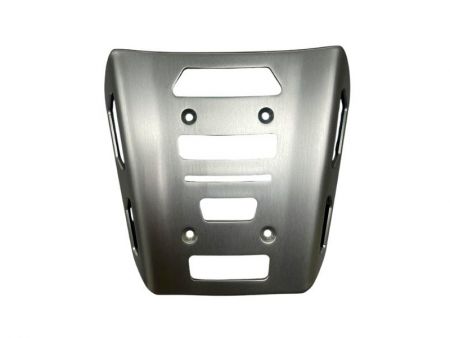
4mm Aluminum Fine Blanking and Cosmetic Part | Custom Motorcycle Luggage Rack
This aluminum motorcycle luggage rack is a custom mass-produced part for motorcycle brands...
Details